
Published · By Henry Palma
Fractions, Decimals, and Coordinate Pairs: Write Math Answers in the Right Form
Many wrong math answers are right answers in the wrong form. Simplify fractions, round only at the end, and keep x before y with this quick pre-submit check.
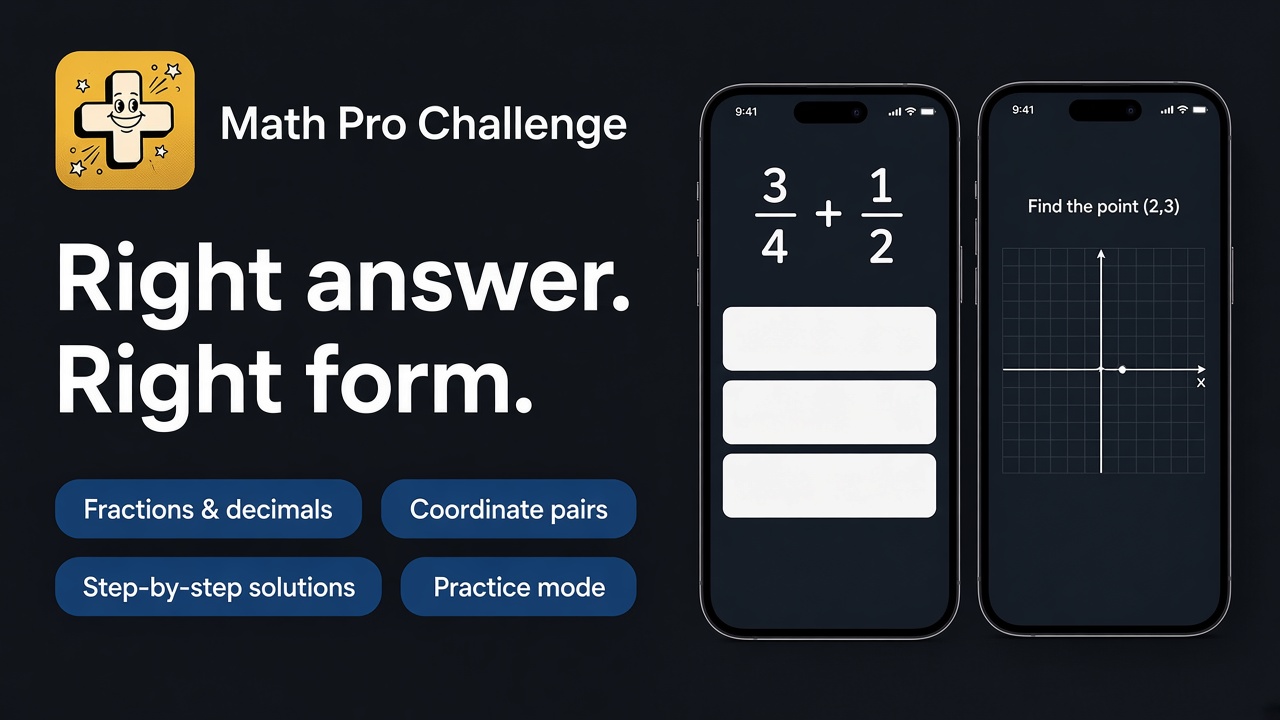

Many "wrong" math answers are right answers written in the wrong form. A fraction that was never simplified, a decimal rounded too early, or a coordinate pair with x and y swapped can cost the point even when the thinking was correct. The fix is to decide what form the answer needs before you start, and to check the form again before you submit.
Decide the answer form before you solve
Read the question once for the math and once for the form. Ask yourself:
- Is the answer a whole number, a fraction, a decimal, or a point?
- Does the question say to round, and to what place?
- Are there units, such as square units for area or cubic units for volume?
Knowing the form up front changes how you work. If the answer should be a fraction, keep the work in fractions instead of converting to decimals halfway through and losing exactness.
Fractions: simplify and keep them exact
A fraction is in simplest form when the numerator and denominator have no common factor other than 1. To simplify, divide both by their greatest common factor.
- 6/8: both are divisible by 2, so it becomes 3/4.
- 12/18: the greatest common factor is 6, so it becomes 2/3.
- 15/5: this divides evenly, so the answer is the whole number 3.
Two more habits help:
- Watch the sign. A negative fraction is usually written with the minus sign in front, as -3/4, not with a negative in both the numerator and denominator.
- Convert mixed numbers on purpose. 1 1/2 and 3/2 are the same value. If a question works with improper fractions, keep the improper form until the end, then convert if the answer needs it.
Decimals: round once, at the end
Rounding in the middle of a problem is one of the most common ways to get an answer that is close but not correct. Each early rounding step adds a small error, and the errors add up.
- Keep full values through every step of the calculation.
- Round only the final answer, to the place the question asks for.
- When the digit after your rounding place is 5 or more, round up. Otherwise, leave it.
For example, rounding 3.146 to the nearest hundredth gives 3.15, because the next digit is 6. Rounding 3.144 gives 3.14.
If the question involves pi, check whether it wants an exact answer in terms of pi, like 9π, or a decimal approximation. Those are different answers.
Coordinate pairs: x first, then y
A point is written as (x, y). The first number is the horizontal position, and the second is the vertical position. Swapping them gives a different point. The point (2, 5) and the point (5, 2) are not the same.
A few checks for coordinate answers:
- Say "over, then up" to yourself as you read or plot a point.
- Check the signs against the quadrant. A point to the left of the y-axis has a negative x value. A point below the x-axis has a negative y value.
- For a midpoint, average the x values and average the y values separately.
Check units in geometry answers
Geometry answers carry units even when you type only the number. Perimeter and circumference are lengths. Area is in square units. Volume is in cubic units. If you find yourself adding a length to an area, something went wrong earlier in the problem. A formula reference helps here, because it reminds you which measurement each formula produces.
Practice the forms on purpose
Math Pro Challenge has dedicated answer controls for fractions, decimals, coordinate pairs, and more, so you can focus on solving and on getting the form right. It also shows the correct answer and a step-by-step solution after you submit, which is the moment to check whether a miss was a math error or a form error.
When a miss turns out to be a form problem, practice that form directly. The app's practice mode lets you focus on Arithmetic, Geometry, or Algebra at Easy, Medium, or Hard difficulty without affecting your challenge stars or competitive record. For coordinate pairs and fractions, a short practice round is often enough to make the habit stick. The built-in geometry reference covers illustrated 2D and 3D formulas for area, perimeter, circumference, volume, and surface area when you need to check which formula applies.
A short pre-submit checklist
Before you submit any answer, take five seconds to check:
- Is the fraction in simplest form?
- Did I round only at the end, to the right place?
- Are x and y in the right order, with the right signs?
- Does the answer match the measurement the question asked for?
Those four questions cover the form mistakes described above, and they work the same in class, on a test, and in a five-question challenge.