
Published · By Henry Palma
How to Choose a Memory Match Difficulty Level and Know When to Move Up
Start at a level you can finish, use your best time to see progress, and move up only when the board feels easy. A simple plan for memory match practice.
Memory match games are easy to start and surprisingly hard to get better at. A lot of that comes down to picking the right difficulty. A board that's too easy teaches you nothing, and one that's too hard turns into random flipping. Here's a simple way to choose a level, track progress, and decide when to move up.
Start where you can finish
The right starting level is the one you can finish without guessing most of the time. If you're new, or you're setting it up for a child or an older relative, start with the easiest level and finish a few boards before you change anything.
A good sign you're at the right level: you make a few mistakes, but you can feel yourself remembering where cards are.
Use your best time as the scoreboard
Feeling like you're improving isn't the same as improving. Your best time gives you a clear number to beat at each level.
A few tips:
- Compare times at the same level. A time on a harder board isn't comparable to one on an easier board.
- Expect some noise. One lucky board can set a record that's hard to beat. Look at whether your typical times are dropping, not just your record.
- Play a few boards in a row. Your second and third boards are usually faster than the first one as you warm up.
When to move up a level
Move up when the current level starts to feel automatic. Good signs:
- You finish most boards without hints.
- Your times have stopped dropping much.
- You rarely flip a card you've already seen by mistake.
When you move up, your times will get slower. That's expected. The goal is to start improving again at the new level.
When to move back down
There's no shame in dropping a level. If a harder board turns into guessing, go back down for a few days and focus on remembering card positions instead of speed. You'll do better when you try again.
Use hints to learn, not to finish
Hints are useful when you're stuck, but leaning on them hides the skill you're practicing. Try finishing a board without them first. If you use a hint, notice which cards you'd forgotten. Often it's cards in the middle of the board.
Change the theme to keep it fresh
Playing the same pictures over and over can get stale. Switching themes changes what you're remembering, and word themes add a reading step that works your memory differently from pictures.
How Memory Match supports this
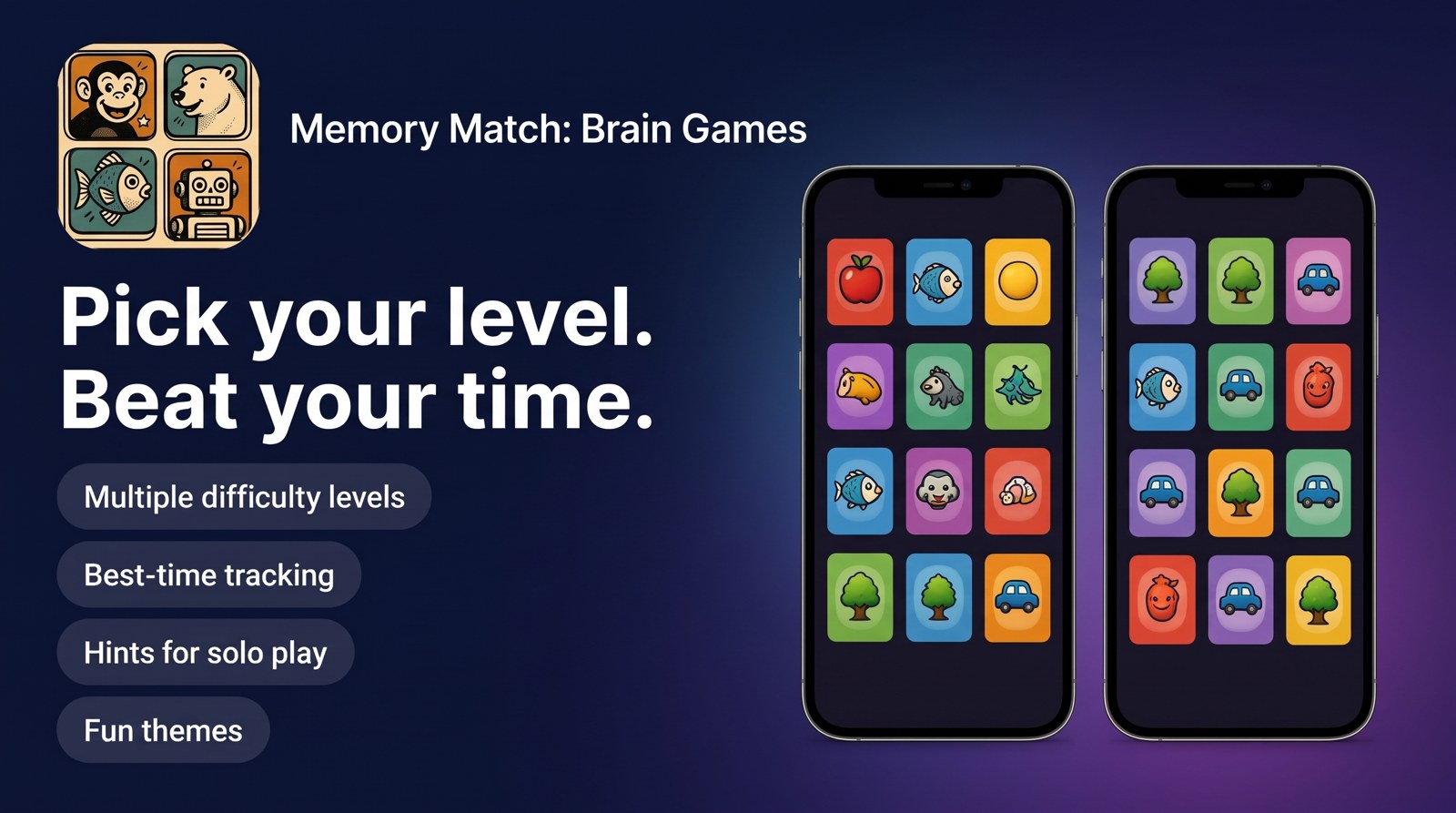
Memory Match: Brain Games has multiple difficulty levels, best-time tracking, and hints for solo play. You can play the Daily challenge, compete with a friend in turn-based two-player mode, and pick from themes including animals, food, robots, numbers, and words, with English and Spanish word matching.