
Published · By Henry Palma
Memory Match Strategy: Flip Unknown Cards First and Remember Positions
Flip an unknown card first, remember positions instead of pictures, and scan the board in order. Simple habits that cut wasted turns and lower your best time.
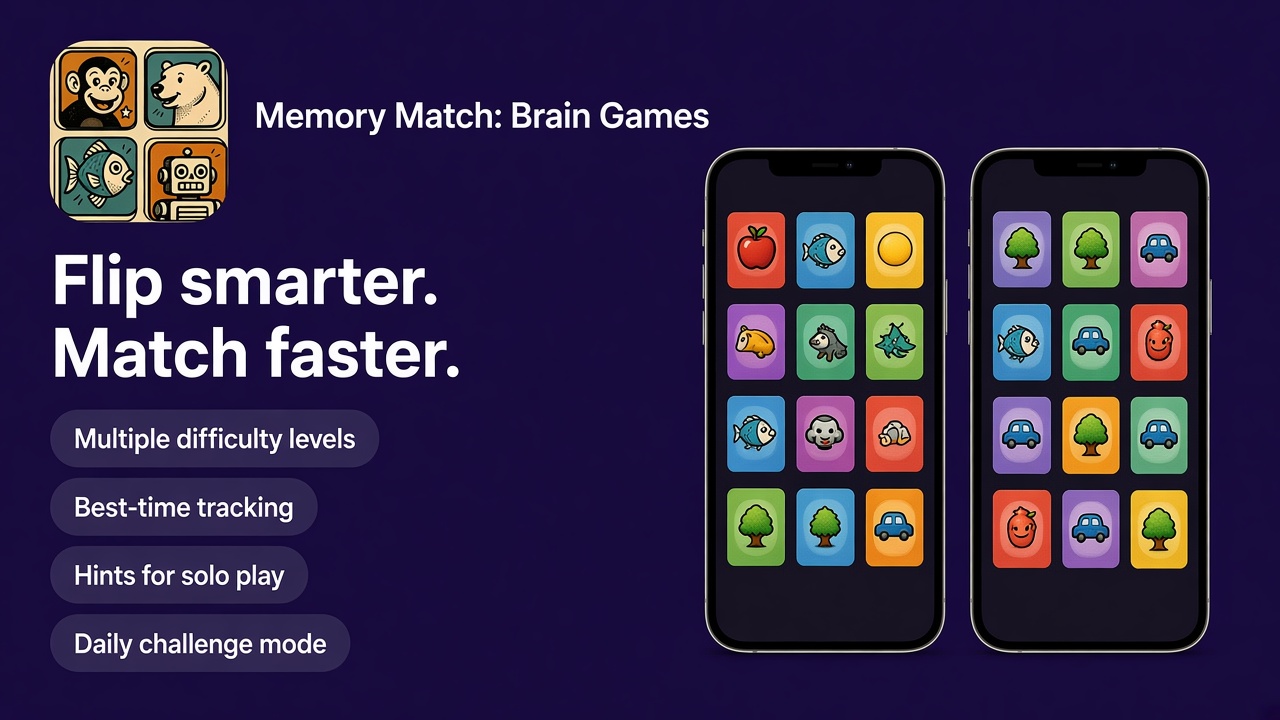

The best memory match strategy is simple: on each turn, flip a card you have never seen first, and only then decide where the second flip goes. If the first card matches one you already know, take the pair. If it does not, use the second flip to reveal another unknown card. That one habit turns every turn into new information instead of a guess, and it is the main thing that separates a slow board from a fast one.
Why random flipping wastes turns
When you flip two cards you have already seen and they do not match, you learned nothing. The board looks the same as it did before the turn. Most wasted moves in a matching game come from this: flipping a familiar card because it feels safe, then guessing at the second one.
A better approach treats the board like a map you are filling in. Every card you reveal adds one more known location. The goal of the early game is to reveal as much of the map as possible. The goal of the late game is to collect pairs you already know.
Rule 1: Flip an unknown card first
Start each turn with a card you have not seen. There are only two outcomes:
- The card matches one you remember. Flip that remembered card and take the pair.
- The card is new, or you do not remember its partner. Use the second flip on another unknown card.
In the second case, you have still added two cards to your map. Even a turn with no match moves you forward.
The exception is when you already know where both cards of a pair are. Take that pair right away so you do not have to keep holding it in memory.
Rule 2: Remember positions, not just pictures
It is easy to remember that you saw a cat. It is harder to remember where. Give each position a simple label in your head, like "top row, third card" or "bottom left corner." Saying the location to yourself as you flip helps it stick.
Rows and corners are the easiest positions to remember. Cards in the middle of a large grid are the ones people lose. When you reveal a middle card, take an extra half second to anchor it to something nearby, such as "two to the right of the dog."
Rule 3: Scan in an order you can repeat
When you reveal unknown cards, go through the board in a consistent order, such as left to right along each row. A pattern makes it easier to keep track of what you have already checked, and it keeps you from flipping the same area over and over while ignoring the rest of the grid.
You do not have to follow the order rigidly. If a match is available, take it. But when you are exploring, a steady sweep beats jumping around.
Rule 4: Use hints after you try to recall
Memory Match: Brain Games has hints for solo play. They are most useful after you have tried to rebuild the board in your head and failed. A hint used too early gets you a pair, but it skips the actual practice, which is the moment of trying to recall a location.
Pick a difficulty you can finish carefully
The app has multiple difficulty levels and tracks your best time, so it is tempting to jump straight to the hardest board. A better progression is to stay at a level until you can finish it without random guessing in the late game, then move up.
Bigger boards change the problem. On a small grid, you can hold most of the board in memory. On a larger one, you cannot, so the strategy above matters more. Locations, scanning order, and taking known pairs quickly all start paying off.
Try to beat your best time the right way
Speed comes from fewer wasted turns, not faster tapping. If your best time is not improving, count how often you flip two cards you have already seen. That number usually drops as the habits above become automatic, and your time drops with it.
A few practical tips:
- Do not rush the first few turns. They build the map for the rest of the game.
- When you find a pair you know, take it immediately.
- If you lose track, slow down for one turn and rebuild the area around the last card you flipped.
Change themes to test what you really remember
The app includes themes such as animals, food, robots, numbers, and words, plus English and Spanish word matching. Many players find pictures easier to recall than numbers or words, because pictures have colors and shapes that stand out. Switching to one of those themes is a good check on whether you are remembering positions or just recognizing a bright picture.
The same strategy works on the Daily puzzle, on any difficulty, and in two-player mode, where every card your opponent reveals is information for you as well.