
Published · By Henry Palma
Number Memory Training: How Dynamic Difficulty Works and Where to Start
Pick a starting length you can almost handle, let dynamic difficulty find your edge, and treat misses as part of the training. A simple plan for number and word recall.
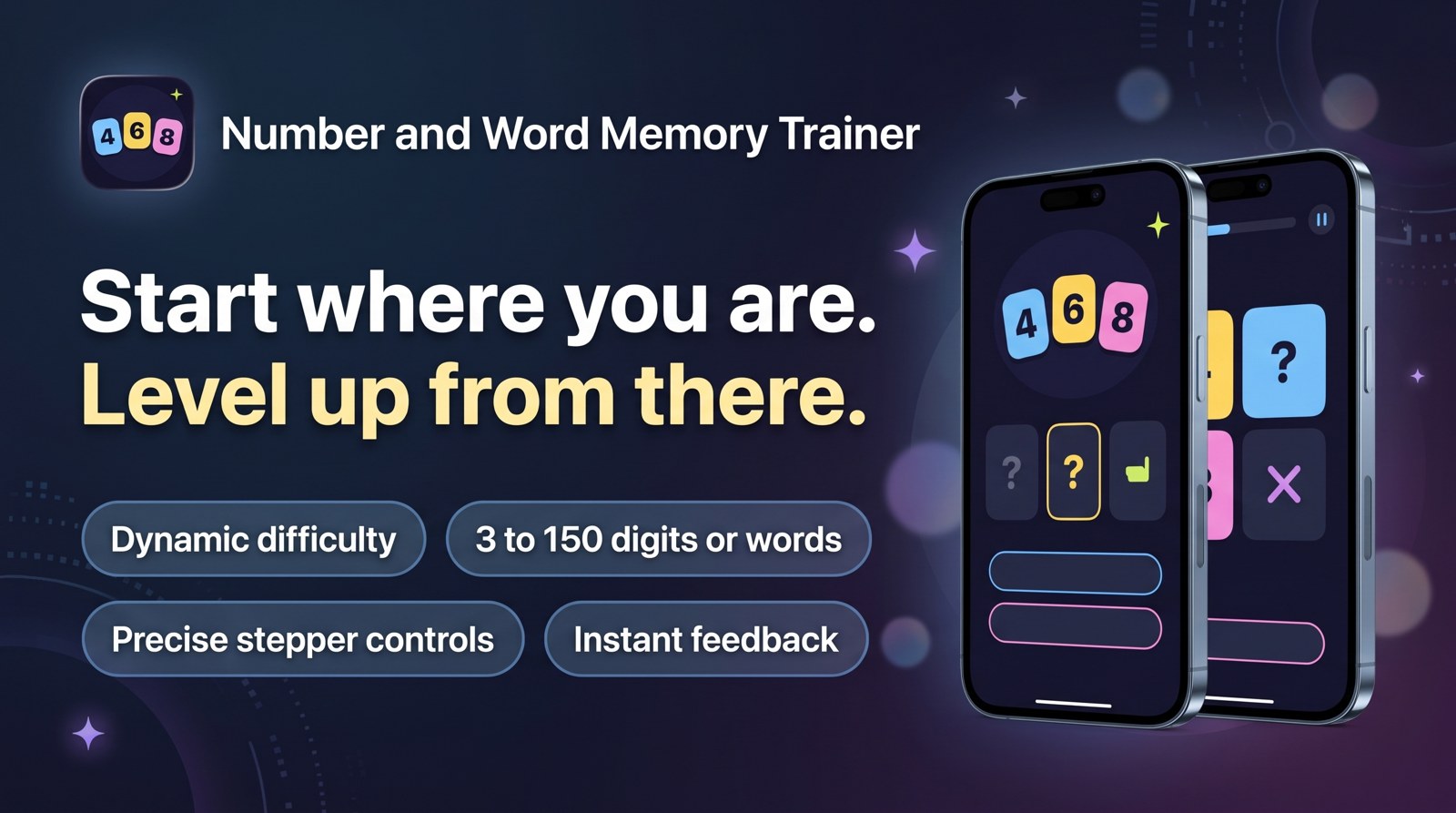

Memory training works best when it's hard, but not too hard. If the sequence is too short, you're coasting. If it's too long, you're just guessing. The sweet spot is right at the edge of what you can remember. Dynamic difficulty helps you find that edge and stay there.
What dynamic difficulty means
The idea is simple:
- Get it right, and the challenge goes up.
- Make a mistake, and the challenge comes down.
Over a session, this pushes you toward the length where you succeed some of the time and miss some of the time. That's the zone where real practice happens.
You don't have to guess how hard to make each round. The training adjusts as you go.
Why missing is part of the plan
Many people feel bad when they miss a round. Don't. A miss is useful information. It tells you where your current limit is.
If you never miss, the training is too easy. You're repeating what you can already do. Hitting your limit, then working back up, is how you stretch it.
A healthy session usually looks like this:
- A few correct answers in a row
- A miss or two as the length climbs
- A step back down, then another climb
Picking your starting length
Your starting point matters less than you'd think, because dynamic difficulty will move you. Still, a good start saves time and frustration.
Some general guidelines:
- Brand new to memory training? Start short. A length you can get right on the first try builds confidence.
- Done some practice before? Start a little below your best recent length, then let it climb.
- Coming back after a break? Drop down a bit. Warm up first, then push.
If your first few rounds are all easy, raise the starting length. If your first round is a miss, lower it. The goal is to begin just under your edge.
Numbers vs. words
Numbers and words train your memory in slightly different ways.
- Numbers are compact and abstract. They're great for focus and quick recall.
- Words carry meaning. You can link them into a story or picture, which some people find easier, and others find harder.
Try both. Switching modes keeps training interesting and shows you which kind of memory needs more work.
A simple 10-minute session
Here's a plan you can use most days:
- Warm up (2 minutes). Start a few steps below your usual length. Get a couple of easy wins.
- Climb (5 minutes). Let dynamic difficulty raise the length. Keep going through the misses.
- Switch modes (2 minutes). Try a few rounds of the other mode, numbers or words.
- Finish strong (1 minute). End on a length you can get right, so you finish with a win.
Short, regular sessions beat long, rare ones. Ten minutes a day is plenty to see progress over time.
Tips for better recall
- Group what you see. Break long numbers into small chunks instead of one long string.
- Say it in your head. A quiet inner voice helps many people hold a sequence.
- Watch the counter as you type. It helps you notice if you've skipped or added an item.
- Stay relaxed. Tension makes recall harder. Take a breath before each round.
How Number and Word Memory Trainer helps
Number and Word Memory Trainer lets you train with number sequences or random word sequences, from 3 to 150 digits or words. Use the precise stepper controls to choose your challenge length, and let dynamic difficulty raise the challenge when you're right and adjust it down after mistakes. You get instant feedback after every round, live number, letter and word counts while you enter your answer, and confetti when you win a level.