
Published · By Henry Palma
Salsa Basic Step for Beginners: Forward, Back, and the Pause
Learn the salsa On1 basic step count by count for leaders and followers, how to break on 1, keep steps small, and a short practice routine for beginners.
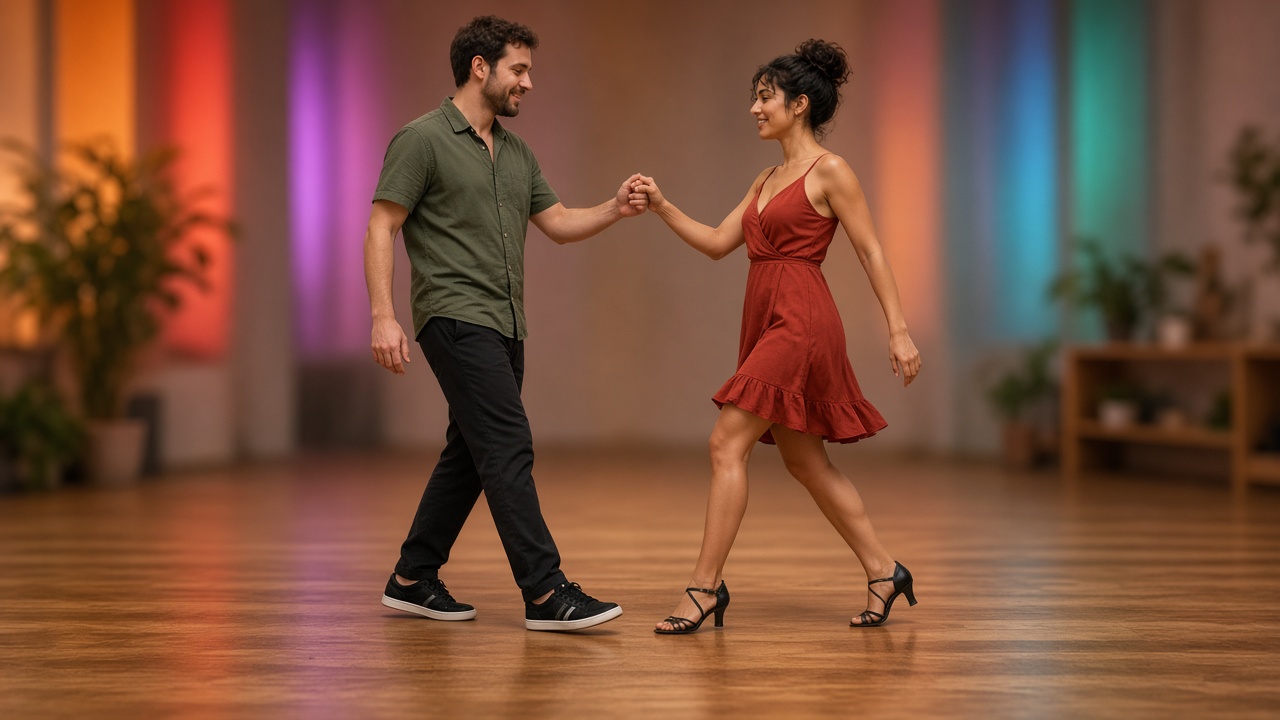
The salsa basic step is six weight changes over eight counts: three steps, a pause, three steps, a pause. If you can step on 1, 2, 3 and 5, 6, 7 and hold still on 4 and 8, you can dance salsa On1 with a partner at your first social.
This post walks through the forward-and-back basic for leaders and followers, the details that make it feel smooth, and a short routine to practice it at home.
How the Salsa Count Works
Salsa music is counted in groups of eight beats. In the On1 style, you step on 1, 2, 3, pause on 4, step on 5, 6, 7, and pause on 8. The pause is not a break in the dance. Your weight stays where it landed on 3 or 7 while you get ready for the next step.
If finding the 1 in a song is still hard, start with our post on how to find the beat in salsa and come back once you can count along to a track.
Leader's Basic Step, Count by Count
Start with your feet together under your hips.
- Count 1: step forward with your left foot.
- Count 2: shift your weight back onto your right foot, which stays in place.
- Count 3: bring your left foot back next to your right.
- Count 4: pause.
- Count 5: step back with your right foot.
- Count 6: shift your weight forward onto your left foot, which stays in place.
- Count 7: bring your right foot back next to your left.
- Count 8: pause.
Follower's Basic Step, Count by Count
The follower mirrors the leader, so when the leader moves forward, the follower moves back.
- Count 1: step back with your right foot.
- Count 2: shift your weight forward onto your left foot.
- Count 3: bring your right foot back next to your left.
- Count 4: pause.
- Count 5: step forward with your left foot.
- Count 6: shift your weight back onto your right foot.
- Count 7: bring your left foot back next to your right.
- Count 8: pause.
The step on 1 and the step on 5 are called the breaks. In On1, the leader breaks forward on 1 and the follower breaks back on 1.
Details That Make the Basic Feel Smooth
Keep your steps small
A big forward step pulls you off balance and makes it hard to get back on time. A step about the length of your foot is plenty. Small steps also keep you close enough to your partner to feel the lead.
Change your weight fully on every step
Each count is a full weight change, not a tap. On count 2, your weight really moves onto the foot that stayed in place. If you only touch the floor with the moving foot, the next step starts on the wrong foot.
Hold the pause
Beginners often rush through 4 and 8 and end up a beat early. Let your weight settle on 3 and 7 and wait for the music. The pause is where you have time to breathe and listen.
Stay upright and relaxed
Keep your chest lifted, your shoulders down, and your knees soft. Look at your partner, not your feet. Hip motion comes from bending and straightening your knees as you change weight, so you don't need to force it.
Common Beginner Mistakes
- Stepping on 4 and 8. This turns the basic into constant marching. Count out loud until the pause feels natural.
- Leaning forward on the break. Step forward with your foot, not your upper body. Your torso stays over your feet.
- Drifting across the floor. If you end up somewhere new after a few eights, your count-3 and count-7 steps are not returning to center.
- Watching your feet. It feels safer, but it breaks your posture and your connection with your partner.
A 10-Minute Practice Routine
- Two minutes, no music: count out loud slowly and do the basic for your role.
- Three minutes, slow salsa song: dance the basic and say the counts out loud.
- Three minutes, same song: dance the basic and only say "1" and "5" out loud.
- Two minutes, a faster song: keep the steps small and focus on holding the pause.
Once the forward-and-back basic feels automatic, practice it as the follower or leader role you don't usually dance. It helps you understand what your partner feels.
Keep the Basic and Its Variations in One Place
Your teacher will soon show you variations of the basic, like the side basic and the back basic, plus your first turns. Save each one as you learn it so you can review it before your next class. You can keep and tag the moves you learn in Sweet Dance Moves Library, then build a practice list of the steps you're working on this week.