
Published · By Henry Palma
How to Run a Fair Vocabulary Duel With a Friend and Learn From It
Same words, your own schedule, and a talk about the misses afterward. How to set up a friendly vocabulary duel in English or Spanish that actually teaches words.
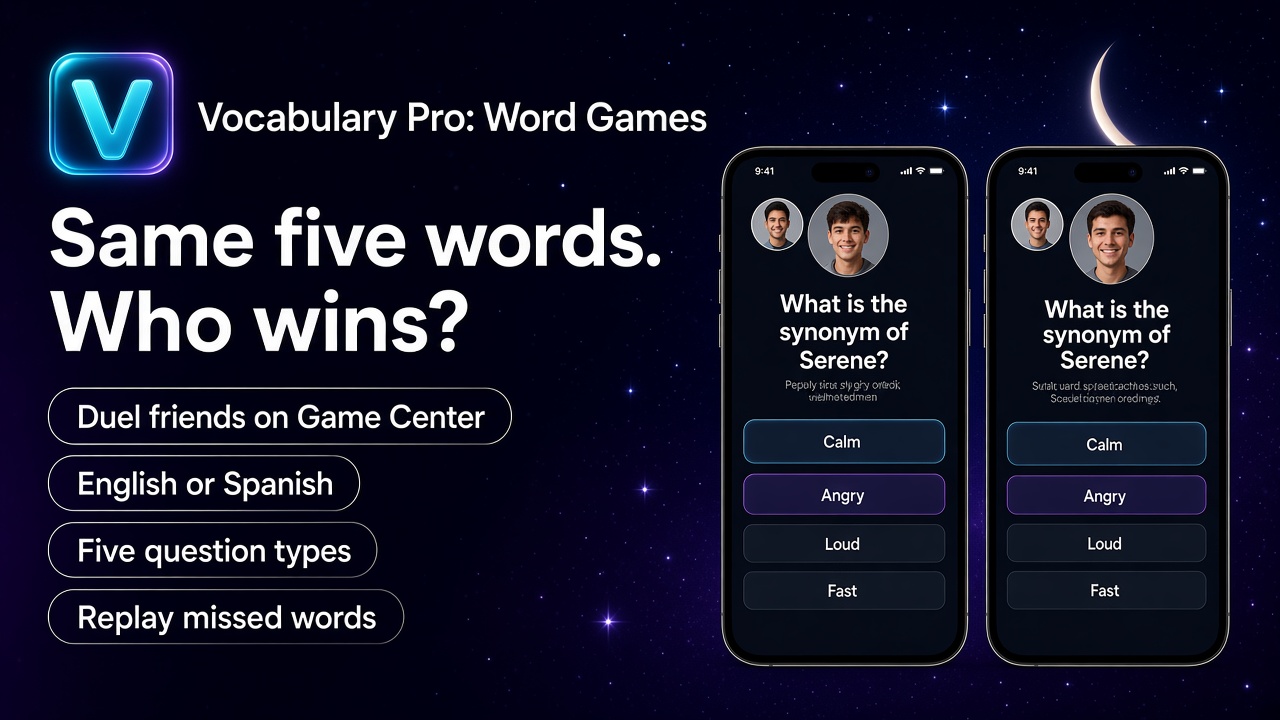

A vocabulary contest with a friend works best when you both answer the same words, play on your own time, and talk about the words afterward. Same words keep it fair. Your own time keeps it easy to fit into a busy day. And comparing answers afterward is where most of the learning happens, because a word your friend knew and you missed is a word worth reviewing.
Why a friendly duel helps you learn words
Solo practice works, but it is easy to skip. A friend waiting for your turn is a small reason to play today. Competition also makes you pay closer attention. When you know someone else got the same word, you want to know what it meant and why you missed it.
Duels also show you what you know compared with someone else. If your friend reads a lot of fiction and you read a lot of news, you will each know words the other one does not. That gap is useful. It points you to words you would not have met in your own reading.
Keep the duel fair
A good word duel has three rules:
- Same words for both players. If each player gets different words, the score says more about luck than vocabulary.
- Time counts. A timed game makes it harder to stop and look words up.
- A clear tiebreak. Decide ahead of time what happens when you both get the same number right.
Vocabulary Pro: Word Games handles all three in its duels. You challenge friends through Game Center on the same 5 words. Each of you takes your turn whenever you like. The player with the most correct answers wins, and if it is a tie, the faster time wins. Wins earn medals and build your duel record.
Play on your own schedule
Turn-based play matters more than it sounds. You do not need to be online at the same time, and nobody has to rush through a round while busy. Take your turn when you can give five words your full attention, then let your friend play when it suits them.
This also makes duels a good fit for people in different time zones, or for a parent and a teenager who are rarely free at the same moment.
Talk about the words afterward
The score is the least useful part of the duel. After both turns are done, look at the words together:
- Which word did only one of you get right?
- Can the person who got it explain what it means, or use it in a sentence?
- Was a miss a spelling slip, or did you not know the word at all?
Every answer in Vocabulary Pro shows you what the word means, so you learn something even when you miss. A quick text about one interesting word turns a game into a small lesson for both of you.
Mix up the question types
Vocabulary Pro uses five question types: Spell It, Synonym, Unscramble, Fill the Blank, and Odd Word Out. Different types reward different strengths. A strong speller may do well on Spell It and Unscramble but slip on Odd Word Out, which asks you to know how several words relate. If one player keeps winning, that mix can show why, and it shows the other player what to practice.
Practice the words you missed
Losing a duel is useful if you follow it with practice. Practice mode lets you choose a question type and difficulty with no timer, or replay the words you missed, and it never touches your stats. A short practice round after a loss is a simple way to go back over the words that beat you.
Duel in English or Spanish
You can switch languages at any time. Spanish mode has its own words, Spanish voices, a keyboard with Ñ and accents, and the whole app in Spanish. That makes duels a good option for language learners. Two friends learning Spanish can challenge each other, or a native speaker can duel a learner in the learner's second language.
What you need to start
Game Center is optional for solo play, but duels run through Game Center. Starting duels with friends is part of Vocabulary Pro's Pro upgrade, along with unlimited Solo Challenges and unlimited Practice. Every day, everyone gets one Solo Challenge and one Practice round at no cost, at any level, so you can try the question types before you decide.
A simple weekly rhythm:
- Send a friend a duel a few times a week.
- After both turns, compare the words one of you missed.
- Practice those missed words before the next duel.