
Published · By Henry Palma
What Is CVA Risk? FRTB Credit Valuation Adjustment Explained
CVA is the discount for the chance a trading partner cannot pay. This post explains the earnings hit, the Basel capital charge, and what it means for regionals.

CVA, the credit valuation adjustment, is the discount for the chance a trading partner can't pay. It can grow when credit spreads widen, even if nobody misses a payment. That increase is a real loss through earnings. In this post, we use a fictional regional bank, Ridgeway Regional Bank, to show what CVA is, how the capital rules treat it, and what it means if you run or oversee a regional bank.
What CVA is
Start with what a swap is worth if everyone pays. Say one swap is worth $10 million to Ridgeway: money the customer owes over time. That value assumes the customer never defaults.
CVA is the discount for the chance they can't pay. It is the expected loss if the customer defaults, and it grows when their credit looks worse. Accounting rules already require it. Fair value is the value if everyone pays, minus CVA.
A $1.2 million loss with no defaults
Ridgeway has about $9 billion in assets. It offers interest-rate swaps to about 120 business borrowers: $1.5 billion of notional, meaning the face amount the payments are based on. It offsets each one with a matching swap at a large dealer bank, another $1.5 billion. And it holds $1 billion of swaps to protect its own interest margin.
Here is a rough rule of thumb. It is not the regulatory formula, but it shows the idea. CVA is about the expected exposure, times the credit spread, times the years left. A credit spread is the extra yield investors demand to lend to a riskier borrower.
Ridgeway could be owed $60 million, on average, across its customer swaps. The customers' credit spread is 2%. The swaps have about four years left. So the CVA reserve is about $4.8 million.
Now the local economy slows, and the market's view of borrowers like Ridgeway's customers gets worse. Their credit spread widens from 2% to 2.5%. Same math: the CVA reserve rises to $6 million. That increase of $1.2 million is a loss through earnings, with zero missed payments.
That is CVA risk: losses when CVA moves, because credit spreads change, or because market moves change the exposure.
Why the capital rules exist
In the 2008 crisis, credit spreads exploded, and banks marked down what shaky trading partners owed them. The Basel Committee found that about two-thirds of losses from trading partners came from these CVA moves, not from actual defaults.
So in December 2010, Basel III added the first capital charge for CVA risk. It was rebuilt in 2017, and updated in July 2020 to line up with FRTB, the Fundamental Review of the Trading Book. The spirit is simple: default is not the only way a trading partner can cost you money.
Three charges, three questions
Counterparty credit risk, or CCR, covers the trading partner actually not paying. CVA risk covers losses before any default, when spreads move. And market risk, under FRTB, covers the trading positions themselves. Three charges, three different questions.
The Basel menu
The Basel rules give a menu.
The default is BA-CVA, the basic approach. Its reduced version is a formula built from exposures, with no credit for hedges. The full version counts credit hedges, but at least a quarter of the charge always stays.
Then there is SA-CVA, the standardized approach. It uses sensitivities to credit spreads and market moves, and supervisors must approve it.
And there is a shortcut for small derivative books.
The basic approach, in numbers
Here is the basic approach for one customer, in its reduced version. Capital equals 0.65, times a risk weight, times the maturity, times the exposure at default, or EAD, times a discount factor, divided by 1.4.
Ridgeway's biggest swap customer is an unrated manufacturer, so the risk weight is 7%. The swap has four years left, and the exposure at default is $14 million. The discount factor, set by the rule, is 0.91. Put it together, and the capital is about $1.65 million. Multiply by 12.5 to get risk-weighted assets, or RWA: about $20.6 million.
Compare that with the default charge on the same swap. Under the standardized credit rules, an unrated company gets a 100% risk weight, and the minimum capital is 8%. So $14 million times 8% is about $1.12 million. The CVA charge, $1.65 million, is bigger than the default charge. Together, about $2.8 million of capital for one swap worth $10 million.
Now all 120 customers. Add up each customer's stand-alone charge, and you get $15.2 million. But the formula assumes spreads are only 50% correlated. They don't all move together. That brings it down to $8 million. Times 0.65, the capital is about $5.2 million. And one big customer drives a big share of it. Concentration costs capital.
These capital examples focus on Ridgeway's customer swaps.
The shortcut for small derivative books
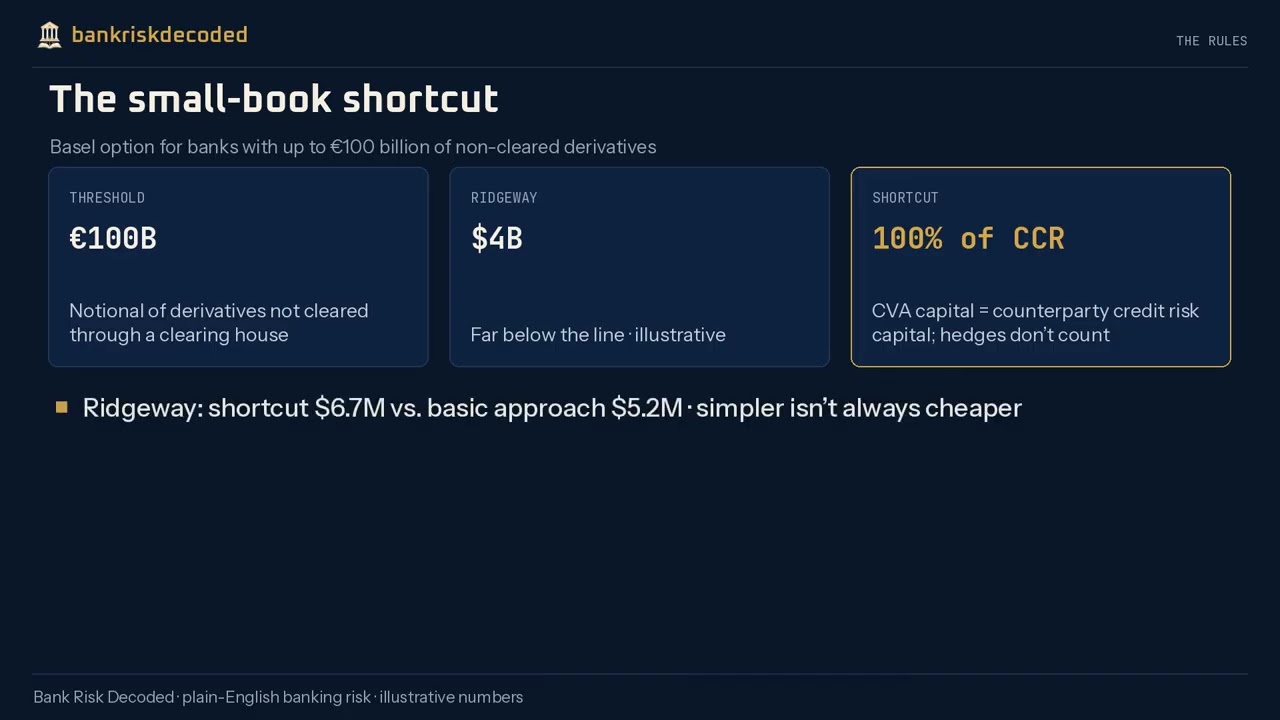
Under Basel, a bank with 100 billion euros or less of derivatives that aren't centrally cleared can skip the CVA math. It can set CVA capital equal to 100% of its counterparty credit risk capital.
Ridgeway has about $4 billion of notional, far below the line. But hedges don't count under the shortcut. For Ridgeway's customer swaps, the shortcut comes to $6.7 million, against $5.2 million under the basic approach. Simpler isn't always cheaper.
The standardized approach
SA-CVA is the FRTB-style option. It measures sensitivities: how much CVA moves when credit spreads, interest rates, currencies and other market factors move, the same idea as the FRTB standardized approach. It recognizes both credit and market hedges, so a well-hedged bank can lower its charge.
The price is a dedicated CVA desk, strong data, and the supervisor's approval. That's built for big dealers, not for a bank of $9 billion.
Trades directly with a qualified central counterparty, or clearing house, are not covered transactions. They carry no CVA charge.
Who holds CVA capital in the United States today
Under the current U.S. rule, only the largest banks, under the advanced approaches, hold a CVA capital charge. Regional banks have no CVA capital charge, but accounting CVA still hits their earnings.
On March 19, 2026, regulators proposed a new version that follows Basel's basic and standardized approaches. It would apply to the largest, most international banks, called Categories I and II, and to big traders with at least $1 trillion of derivatives. As of mid-November 2026, it is still a proposal, not a final rule. Fed leaders have said they expect to finalize the rules before year-end.
How CVA shows up in pricing
A customer takes a five-year loan of $20 million and swaps it to a fixed rate. On average, Ridgeway could be owed about $1 million on that swap. The customer's credit spread is 3%, over five years. So the CVA is about $150,000. Spread over the loan, that's about 0.15% a year, built into the customer's swap rate. Skip the charge, and you give the credit risk away for free.
Five tools for managing CVA risk
- Collateral: daily margin shrinks the exposure.
- Netting agreements, so there's one net amount per trading partner.
- Central clearing: trades with a qualified clearing house carry no CVA charge.
- Credit hedges, like credit default swaps on the trading partner or on an index.
- Pricing and limits: charge CVA up front, and cap the exposure to any one name.
Five common CVA mistakes
- Thinking no default means no loss.
- Pricing swaps without a CVA charge.
- Ignoring wrong-way risk, when the exposure grows just as the customer's credit weakens. Ridgeway's customers pay fixed, so if rates fall in a recession, they owe more just as business slows.
- No collateral or netting agreements in place.
- Letting one customer's exposure grow unchecked.
What this means for a regional bank
First, you likely have no CVA capital charge today, but CVA still hits your earnings. Second, price CVA into every customer swap. Third, watch your biggest names and wrong-way risk. And fourth, track the capital rules. Final U.S. rules are expected soon, so check whether they touch you.
Five questions to ask your team
- What is our CVA reserve today, and what moved it?
- Do we charge CVA in every swap price?
- Who are our biggest swap exposures?
- Where are we exposed to wrong-way risk?
- And would the new capital rules apply to us?
Recap
CVA is the price of a trading partner's credit risk. Spreads can widen with zero defaults, and that's a real loss. In the 2008 crisis, about two-thirds of losses from trading partners were CVA moves. Basel offers the basic approach, the standardized approach, or, for small books, 100% of the counterparty credit risk charge. In the U.S., only the biggest banks hold CVA capital, and the new rules are still a proposal.
Next in the series is market risk, the risk of losses when prices move. Watch more Bank Risk Decoded videos on the Bank Risk Decoded YouTube channel.
Check your understanding
1. CVA, the credit valuation adjustment, is: - A. The cash a bank holds at the Fed - B. The discount for the chance a trading partner can't pay - C. The same as a missed payment - D. A type of deposit insurance
2. In the Ridgeway rule-of-thumb example, the $1.2 million earnings loss happened because: - A. A customer missed a payment - B. A customer defaulted - C. Credit spreads widened from 2% to 2.5%, lifting the CVA reserve from about $4.8 million to $6 million, with zero missed payments - D. The bank sold the swaps at a $1.8 billion loss
3. In the 2008 crisis, the Basel Committee found that about: - A. All counterparty losses were actual defaults - B. Two-thirds of losses from trading partners came from CVA moves, not actual defaults - C. CVA was not used in accounting - D. One-tenth of losses were CVA moves
4. Under the Basel menu, the default method is: - A. SA-CVA, which every regional bank must use - B. BA-CVA, the basic approach; SA-CVA needs supervisory approval; and a small-book shortcut can set CVA capital equal to 100% of counterparty credit risk capital - C. No capital charge for any bank - D. Only central clearing
5. In the United States today, and under the March 19, 2026 re-proposal: - A. Every regional bank already has a CVA capital charge - B. Only the largest banks, under the advanced approaches, hold a CVA capital charge today; the 2026 re-proposal is still not final as of mid-November 2026 - C. The re-proposal is already a final rule - D. Accounting CVA does not hit earnings at regional banks
Answer key
- B. Fair value is the value if everyone pays, minus CVA, and the discount grows when credit looks worse.
- C. That $1.2 million increase in the CVA reserve is a loss through earnings with zero missed payments.
- B. About two-thirds of the losses from trading partners were CVA moves, which is why Basel added a CVA capital charge.
- B. BA-CVA is the default; SA-CVA needs approval; the shortcut is available for small, non-centrally cleared books of 100 billion euros or less.
- B. Regional banks have no CVA capital charge today, but accounting CVA still hits earnings, and the March 19, 2026 re-proposal is not final.