
Published · By Henry Palma
Gig Driver Vehicle Maintenance Costs: What to Track and Why
Log each oil change, tire, and repair with date, amount, mileage, and receipt. See how maintenance fits the standard mileage rate and your real cost per mile.
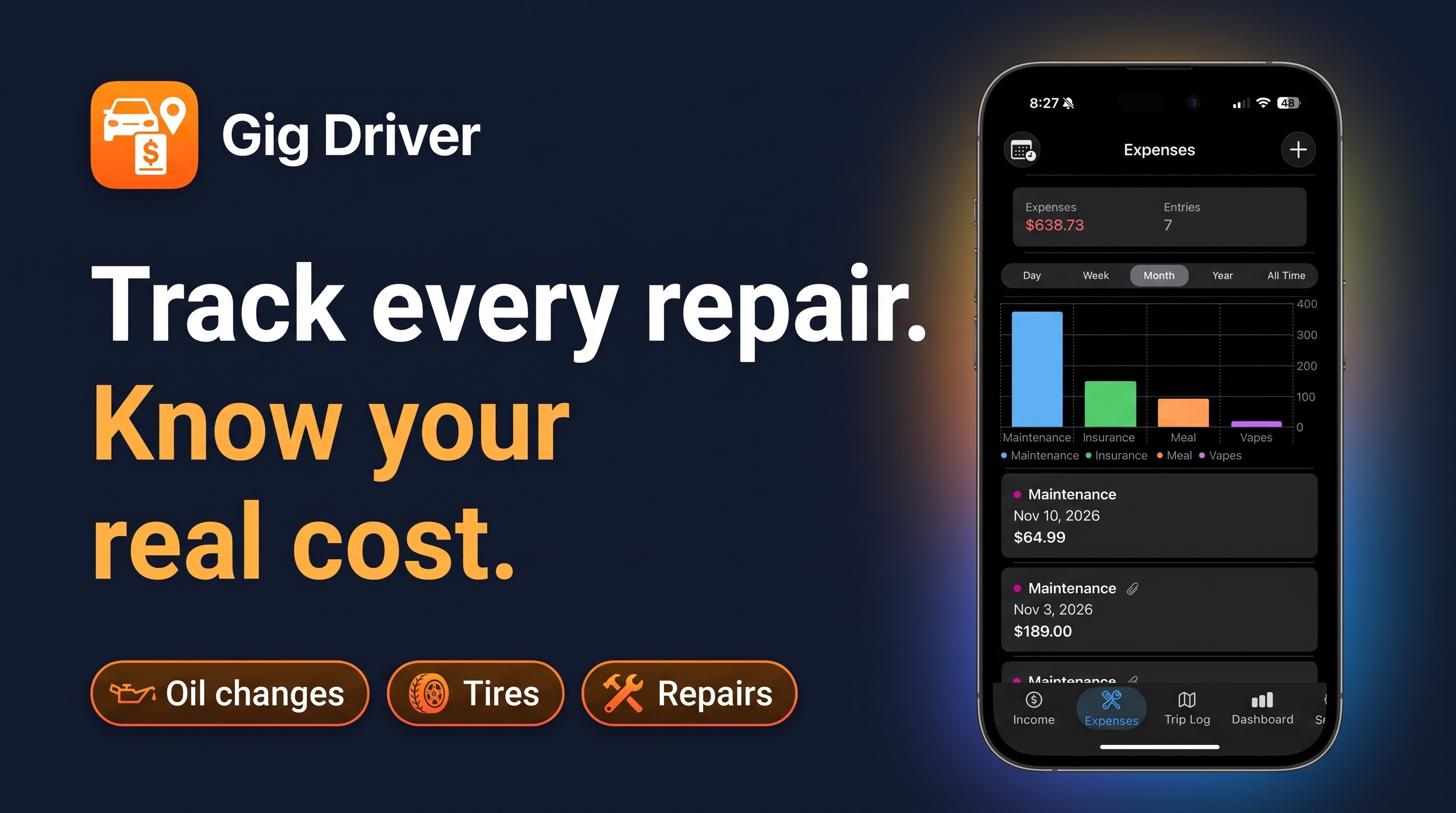
Log every oil change, tire, brake job, and repair with the date, amount, mileage, and a receipt, even if you plan to take the standard mileage rate. Those records show what your car really costs per mile, tell you when the next service is due, and back up your numbers if you ever switch to deducting actual expenses.

Why maintenance costs matter more for gig drivers
Rideshare and delivery work puts a lot of miles on a car. Oil changes, tires, and brakes come around faster than they do for someone who only commutes. If you only look at what the apps pay you, those costs stay invisible until a big repair bill shows up all at once.
Tracking them as they happen turns a surprise into a number you already expected.
What to record for each maintenance expense
For every service or repair, write down:
- Date of the work
- Amount you paid, including parts, labor, and tax
- What was done, such as oil change, new tires, brake pads, or battery
- Odometer reading at the time of service
- Where it was done (shop or store name)
- Receipt or invoice, photographed the same day
The odometer reading is the one people skip most often, and it is the one that tells you when the next service is due and how many miles each part actually lasted.
Standard mileage rate vs. actual expenses
This is where maintenance records and taxes connect, so it helps to know the basic rule.
According to IRS Publication 463, if you use the standard mileage rate for a year, you can't also deduct your actual car expenses for that year, and that includes maintenance and repairs, gas, oil, insurance, and registration. The rate is meant to cover the cost of operating the car.
If you use the actual expense method instead, repairs, tires, oil, gas, insurance, and other operating costs are among the expenses you may be able to deduct, generally based on the share of the car's use that is for business. Publication 463 explains the rules for choosing between the two methods and when you can switch.
Either way, keep the maintenance records. With the standard mileage rate they still tell you your true cost of driving. With actual expenses they are the expenses. Which method is better for you depends on your car and your miles, so check the IRS guidance or ask a tax professional.
Turn your records into a cost per mile
Once you have a few months of entries, add up your maintenance spending for the period and divide it by the miles you drove in that period. The result is your maintenance cost per mile.
That number helps you judge whether a trip or a delivery is worth taking. A payout that looks fine can turn thin once you account for the wear it puts on your car.
Plan for the next service
Use your odometer readings to see when routine work is coming up. If your last oil change was logged at a certain mileage, you know roughly when the next one is due based on your car's maintenance schedule. Setting money aside each week for the next service is easier than covering it in one hit.
A service history also helps when you sell
A dated log of maintenance with receipts is a service history. When you sell or trade in the car, being able to show when the oil was changed and what was repaired gives a buyer a reason to trust the car.
Keeping maintenance with the rest of your numbers
A notebook in the glove box works if you keep it up. If you'd rather keep maintenance next to your income and mileage, Gig Driver: Income Tracker lets you log maintenance as its own expense category. Scan Receipt pulls the amount and date from a receipt photo and keeps the receipt attached to the entry. Your maintenance sits alongside income from each gig app and the miles in your Trip Log, so you can see profit after expenses in one place.
Whatever you use, the habit is simple: every time the car gets work done, log the date, the amount, the mileage, and the receipt before you drive off.